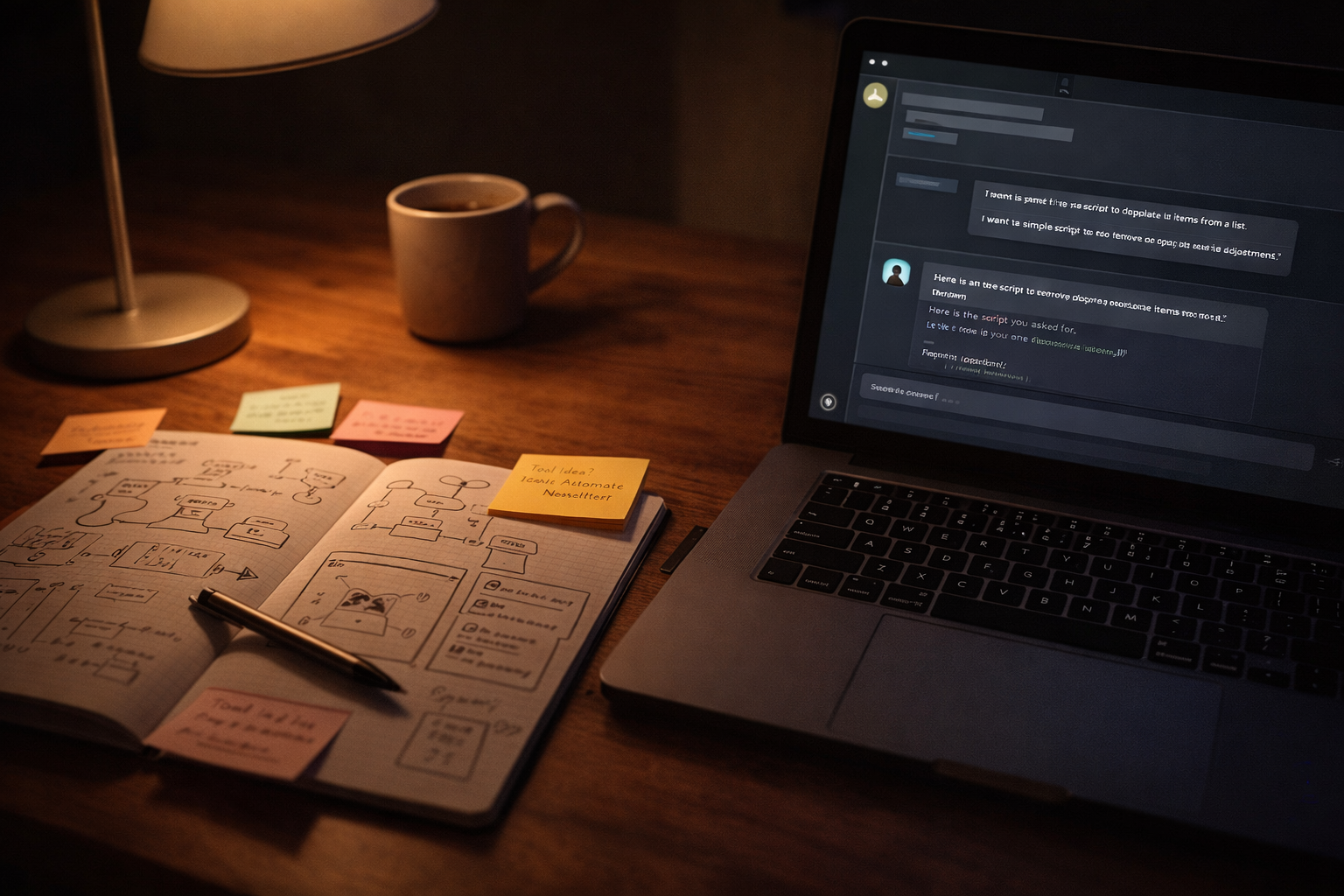
Vibe Coding: Building Things You’re Not “Qualified” to Build
AI doesn’t have to be doom or hype. Sometimes it’s just a creative partner that helps you turn ideas into reality—faster than your skillset.
These days, the air feels electric. AI is everywhere, the workplace is shifting under our feet, and a lot of people seem stuck between two moods: panic or hype. I’ve been trying a third option.
I build things.
Not because I suddenly became a “real developer,” but because these new tools let me move faster than my skillset used to allow. That’s the whole spirit of vibe coding—and honestly, it’s the most fun I’ve had with technology in years.
What is vibe coding?
Vibe coding is when you describe what you want a piece of software to do in plain language—almost like you’re describing a feeling, a behavior, a vibe—and a large language model drafts the code. You’re not handing over the wheel. You’re steering. You guide, test, refine, and keep asking for adjustments until the thing becomes real.
It shifts your role from “typing perfect code” to “directing the outcome.” Less blank-page dread. More momentum.
And momentum is everything.
The real power: creativity without permission
The biggest surprise with vibe coding isn’t speed. It’s confidence.
When the technical gatekeeping drops, you start thinking differently. You stop asking, “Am I allowed to do this?” and start asking, “What if this existed?” Then you try it. Then you tweak it. Then you learn something accidentally.
That “accidentally” part matters. Because you don’t learn vibe coding by sitting in a classroom. You learn it by trying to build something slightly beyond you… and then pulling it back into reality one small revision at a time.
Building First, Figuring It Out Later
If you’ve ever wanted to automate something with Python, build a little web tool, or create a tiny app—but felt like you didn’t have the background—vibe coding is basically a shortcut around the intimidation.
You can start with:
“I want a script that takes a list and removes duplicates.”
“I want a page that saves my notes locally.”
“I want a button that changes the theme and remembers the setting.”
The model gives you a first draft. It probably won’t be perfect. That’s fine. You respond like you’re working with a slightly overconfident assistant:
“That broke when I clicked it twice.”
“Make the text bigger.”
“Don’t reset the score.”
“Make it work on mobile.”
“Okay, now make it less ugly.”
And over time, you start picking up the logic of it all. Not from textbooks—just from repetition and curiosity. It’s almost like coding by osmosis.
Prototyping at the speed of thought
Before vibe coding, a lot of ideas died in the planning stage. You’d think of something cool and then remember the mountain of steps between “idea” and “working.”
Now you can prototype in minutes.
This is especially true if you’re using low-code and no-code tools, or mixing them with small bits of generated code. You can get a rough version running quickly, then improve it in layers instead of trying to build perfection from scratch.
It’s like sketching instead of sculpting marble.
Automation: small lever, big lift
One of the most practical uses for vibe coding is automation—especially for people who aren’t “technical” in a traditional sense.
If you live inside email, spreadsheets, forms, Teams/Slack, or recurring tasks that make you quietly resent your job… automation is where vibe coding starts paying rent.
You can describe your workflow in plain language and get help building it:
route info from one place to another
format it cleanly
reduce repetitive steps
catch errors
generate summaries
turn chaos into a process
And even if you never become a hardcore programmer, you become something just as valuable: someone who can design systems that save time.
Gaming: the sneaky creativity lab
This one surprised me the most: vibe coding makes game-making oddly accessible.
Even small games teach you a lot—logic, rules, feedback loops, balance, pacing. You’re forced to think like a designer and a tester. And those skills spill into everything else: building tools, automating workflows, even solving boring problems at work.
It’s also just… fun.
Sometimes you need fun again. Sometimes that’s the whole point.
Where do you actually vibe code?
You can vibe code anywhere you can talk to an AI and test what it gives you. The simplest way is to use an LLM (like ChatGPT, Claude, or Gemini), describe what you want, and then paste the code into a place that can run it. For quick experiments, that might be an online editor like Replit, CodePen (for web stuff), or a basic local setup on your computer. If you’re building something bigger, you can use an editor like VS Code and have the AI help you write and revise the code as you go. And if you’re more into workflow automation than “coding,” the same vibe applies inside tools like Power Automate or Make—describe the workflow, build a first version, then iterate until it feels right.
Why I think vibe coding matters right now
I don’t think vibe coding is about pretending you’re a senior engineer. It’s not cosplay.
It’s about getting your ideas out of your head and into the world.
It’s about learning by doing. Creating before you feel ready. And discovering that the boundary of “what you can build” is more flexible than you thought—especially when you have an AI collaborator that never gets tired, never gets annoyed, and will happily rewrite the same function ten times until it behaves.
The world is changing fast. That part is true.
But this is also the first time in a long time that regular people can build tools, workflows, and weird little experiments without needing a formal invitation from the tech gate.
So if you’ve been feeling that anxious “Where do I fit in?” energy lately—try building something small. Something playful. Something useful. Something slightly beyond you.
You don’t need to be “qualified.”
You just need a vibe… and the willingness to iterate until it works.

The 3 Coolest Make-Believe Alien vs Cryptid Battles
Different tool, different rules: quantum computing doesn’t “guess faster”—it sets up the problem so the wrong answers cancel out and the right one survives.
The 3 Coolest Make-Believe Alien vs Cryptid Battles
[Written by Casey T. Duncan]
I don’t know what it says about me that my brain does this, but it does: I’ll be doing something normal—counting my He-Man figures—and suddenly I’m like… who wins in a fight between a Grey alien and Bigfoot? Not “who’s real” (calm down, internet). This is purely imaginary pay-per-view energy.
So here are three matchups I’d pay good money to see.
1) Roswell Grey vs Bigfoot
Location: Pacific Northwest tree line, fog on maximum setting.
Vibe: “I can freeze your mind” vs “I can end your bloodline.”
The Grey steps out like it owns the scene—silent, smooth, with that calm little hand lift like it’s about to tap a touchscreen in the air. Then it does the classic move: freeze the room—mind-state shutdown. Birds stop mid-tweet. The wind holds its breath. Even the fog seems to pause and wait for instructions.
Bigfoot… does not get the instructions.
How it goes:
The Grey tries to lock Bigfoot in a psychic box: be still, be calm, be studied.
Bigfoot counters with the most disrespectful response possible: Andre-the-Giant strength with Ric Flair energy.
We’re talking a full “grab-by-the-torso, spin once, and throw you like a lawn chair” situation.
The Grey makes a noise that can only be described as “ultra mega super regret.”
Winner: Bigfoot, decisively.
Post-fight headline: “Elusive Ape Man Goes Viral on Instagram”
2) Reptilian vs Werewolf
Location: A foggy Texas pasture, 3:12 AM.
Vibe: Aggressive strategist vs lunar chaos.
Let’s be honest: this one is close.
Reptilians aren’t just “schemey.” They’re strong, fast, and aggressive—like a heavyweight fighter who also took an honors course in intimidation. They don’t posture; they advance. This is the kind of opponent that doesn’t miss twice.
Werewolf shows up looking like a bad decision given fur and teeth. But here’s the key: werewolf power isn’t constant. It’s a dial.
How it goes (and why it’s close):
The Reptilian comes in hot—clean strikes, ugly slashes, brutal speed, and that cold “I’ve done this before” confidence.
The werewolf takes damage early. Like, real damage. If you bet on the Reptilian in the first 30 seconds, you’re feeling smart.
The pasture fog swirls. The fence posts creak. The tension is thick enough to bottle and sell at Buc-ee’s.
Then the moon shifts.
Full moon power hits and the werewolf stops fighting like an animal and starts fighting like a natural disaster.
The Reptilian lands another heavy blow… and the werewolf barely notices.
The werewolf’s strength spikes like somebody just plugged it into a wall outlet.
What was “close” becomes “oh no.”
Winner: Werewolf—by full moon cheat code.
Important note: any other night? This might go the other way.
Post-fight headline: “Texas Pasture Quiet Again After Brief Incident Involving Fog, Teeth, And Regret.”
3) Insectoid vs Fresno Nightcrawler (The Ghost Pants Cryptid)
Location: Fresno, California backyard at 2:17 AM, security cam quality set to “2007.”
Vibe: Ancient hive intelligence vs a pair of haunted trousers on a peaceful stroll.
If you don’t remember the Fresno Nightcrawler: it looks like walking white pants—no torso, no arms, just pure “laundry spirit” energy. It doesn’t menace. It glides. It’s the most polite cryptid of all time.
Insectoid shows up like the universe’s scariest scientist—tall, angular, quiet, with the vibe of someone who judges your entire species in one look.
How it goes:
The Insectoid tries to scan it.
The pants do not scan. The pants simply continue being pants.
The Insectoid pauses, recalculates, and experiences something new: confusion.
The Nightcrawler drifts away like it’s late for absolutely nothing.
Winner: Fresno Nightcrawler, by being unbothered and unexplainable.
Post-fight headline: “Creepy Insect Dude Defeated By Casual Stroll.”
Final Ranking (Based on Coolness, Not Science)
Fresno Nightcrawler (unbothered champion)
Bigfoot (forest tank, suplex adjacent)
Werewolf (full moon = unfair advantage)
If you disagree, that’s fine. This is Side Column. We can argue politely like adults and then immediately change the subject to action figures.